Buying guide · Headphones
Best headphones for listening to vinyl
Six wired pairs for six situations, picked from the makers’ own spec sheets and independent measurements. Plus how to get a turntable into headphones.
No scores, no lab claims. Shop links are plain links; they may earn us a commission later. How we pick
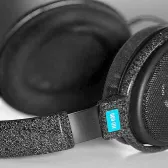 Best overall for home vinyl listeningSennheiser HD 600
Open · Over-ear · 300 Ω
≈1.4 V for 100 dB (est.) · Receiver or headphone amp See it at Thomann
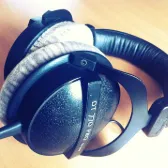 Best closed-back for a shared roombeyerdynamic DT 770 PRO (80 Ω)
Closed · Over-ear · 80 Ω
0.45–1.6 V for 100 dB (est.) · Receiver or headphone amp See it at Thomann
≈0.22 V for 100 dB (est.) · A phone is enough See it at Thomann
 Best budgetKoss Porta Pro
On-ear · 60 Ω
≈0.22 V for 100 dB (est.) · A phone is enough See it at the maker
 Best first open-back without an ampGrado SR80
Open · 38 Ω
≈0.25 V for 100 dB (est.) · A phone is enough See it at the maker
≈0.63 V for 100 dB (est.) · Receiver or amp; a phone may fall short See it at Thomann
First: how a turntable reaches your headphones
Most turntables have no headphone jack. The stylus puts out a tiny signal that also needs the RIAA equalisation curve applied before it sounds right. That is the job of a phono preamp. After it, something has to drive the headphones.
- TurntableCartridge and stylus read the groove.
- Phono preampBuilt into many turntables and receivers, or a separate box.
- Amp with headphone outA receiver or amplifier, or a dedicated headphone amp.
- HeadphonesInto the 6.3 mm or 3.5 mm jack.
Which of these do you already have?
- A receiver or amplifier with a “Phono” input and a headphone jack. Plug the turntable into Phono, the headphones into the jack. Nothing else to buy.
- A turntable with a built-in preamp (often a “Phono/Line” switch on the back). Set it to Line and connect it to any amplifier input; use the amplifier’s headphone jack. If your amplifier has no headphone jack, a headphone amp takes the turntable’s line signal directly.
- Neither. Turntable → separate phono preamp → headphone amp → headphones. Some boxes combine the preamp and the headphone amp.
Don’t plug headphones into the turntable’s RCA outputs: they are meant to feed an amplifier input, not a pair of headphones. Some turntables also send Bluetooth to wireless headphones, which skips all of this; our picks here are wired.
Will your gear drive them? A loudness estimate
The makers publish how loud each headphone plays for a given input. From that we work out how many volts each pair needs to reach 100 dB, which we take as loud peaks at a normal listening level. Fewer volts means easier to drive.
| Headphone | Impedance | Sensitivity, as published | Volts for 100 dB | What it needs | Jack under |
|---|---|---|---|---|---|
| Sennheiser HD 600 | 300 Ω | 97 dB SPL at 1 V | about 1.4 V | Receiver or headphone amp | 37.5 Ω |
| beyerdynamic DT 770 PRO (80 Ω) | 80 Ω | 96 dB (1 mW or 1 V not stated) | 0.45–1.6 V | Receiver or headphone amp | 10.0 Ω |
| Audio-Technica ATH-M50x | 38 Ω | 99 dB SPL at 1 mW | about 0.22 V | A phone is enough | 4.8 Ω |
| Koss Porta Pro | 60 Ω | 101 dB SPL at 1 mW | about 0.22 V | A phone is enough | 7.5 Ω |
| Grado SR80 | 38 Ω | 98 dB SPL at 1 mW | about 0.25 V | A phone is enough | 4.8 Ω |
| Sennheiser HD 660S2 | 300 Ω | 104 dB SPL at 1 V | about 0.63 V | Receiver or amp; a phone may fall short | 37.5 Ω |
The formula. Makers state sensitivity either per volt or per milliwatt:
S is the published sensitivity in dB; ohms is the impedance.
Our assumptions, not measurements. 100 dB as the loudest peaks you want. A phone or USB-C dongle gives roughly 0.5 V; a receiver or headphone amp gives 1 V or more. Your device may differ: look for “output voltage” or “output power into 32 Ω” in its spec sheet. The estimate ignores the jack’s own output impedance, which lowers the voltage that reaches the headphones. beyerdynamic doesn’t say whether its 96 dB is per milliwatt or per volt, so the DT 770 PRO gets a range.
Why impedance matters on a receiver
Every headphone jack has its own output impedance, and makers rarely publish it. A widely used rule of thumb is that the jack’s output impedance should be under one eighth of the headphone’s impedance; above that, the bass can loosen and the tonal balance can shift (NwAvGuy, “Headphone & amp impedance”). The “Jack under” column gives that limit for each pick. This is why 300 Ω headphones are the safe bet on an unknown receiver jack, and why the 38 Ω pairs want a modern, low-impedance output.
The picks in detail
Each pick says what it suits and what to watch for, using only the published specs below it. Where a maker doesn’t publish a spec, we say so rather than fill it in.
Pick 1 · Best overall for home vinyl listening
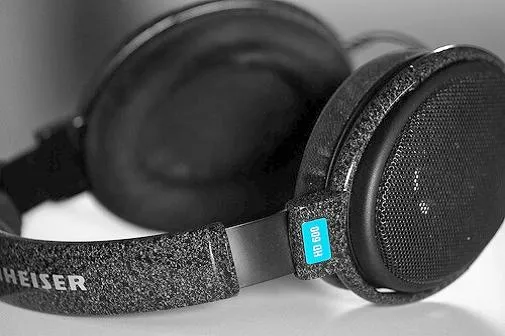
Sennheiser HD 600
Open-back reference headphone with a 3 m detachable cable and a 300 Ω load that suits receiver headphone jacks. Wants a receiver or amp, not a phone.

Why it suits vinyl
- Open-back, so it suits a quiet room where you sit down and play a whole side.
- At 300 Ω it is, with the HD 660S2, the least fussy of our picks about the headphone jack it plugs into. Receiver jacks rarely publish their output impedance, and a high one changes the sound of low-impedance headphones much more (see the 1/8 rule in the loudness section).
- The 3 m cable reaches from a receiver on a shelf to a chair. It is detachable, and Sennheiser sells a 3 m replacement and says most parts are modular.
Watch out for
- Our estimate is about 1.4 V for 100 dB, the most of any pick whose maker states the reference. Plan on a receiver or a headphone amp, not a phone.
- Open-back sound leaks both ways. Others in the room hear your record, and you hear the room.
Published specs
- Open or closed
- Open
- Fit
- Over-ear
- Driver
- Dynamic, 42 mm
- Impedance
- 300 Ω
- Sensitivity
- 97 dB SPL at 1 V
- Weight
- 260 g
- Cable
- 3 m; detachable
- Plug
- 3.5 mm plug, 6.3 mm adapter included
- Volts for 100 dB
- about 1.4 V how
- Jack should be under
- 37.5 Ω output impedance why
- Sennheiser product page: open/closed, fit, driver, impedance, sensitivity, weight, cable, connector. Checked 27 Oct 2026.
- Sennheiser support: HD 600 specifications: Same spec table: 300 Ω, 97 dB (1 V), 260 g, 3 m cable.
- Note: Driver: The same page also mentions a 38 mm diaphragm; the 42 mm figure is the driver.
- Note: Connector: Sennheiser's product text describes it the other way round (a 6.3 mm plug with a 3.5 mm adapter). Either way an adapter is in the box.
- Frequency-response measurements: oratory1990 · crinacle (GRAS 43AG-7) (via the AutoEq project).
Pick 2 · Best closed-back for a shared room
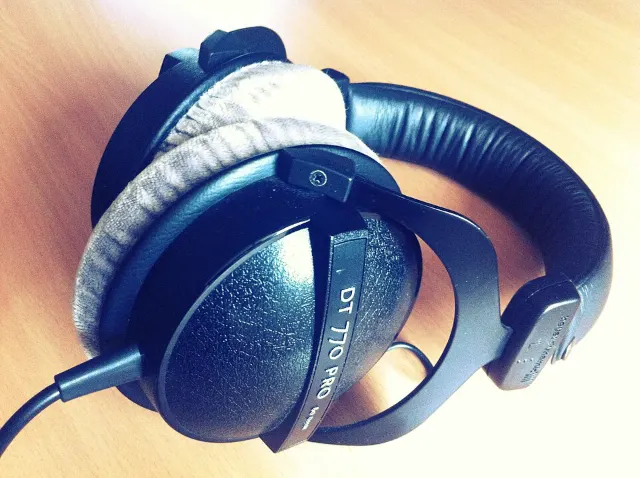
beyerdynamic DT 770 PRO (80 Ω)
Closed studio headphone with velour pads, a 3 m cable and spare parts for nearly everything. Keeps your record to yourself.

Why it suits vinyl
- Closed-back: it keeps most of your record in and some of the room out. beyerdynamic's data sheet gives about 18 dBA of ambient noise isolation for the 80 Ω version.
- The 3 m cable reaches a receiver across the room.
- beyerdynamic sells ear pads, headbands, cables, driver systems and housings as spare parts, so one worn part doesn't retire the pair.
Watch out for
- The cable is fixed, not plug-in. A damaged cable means a repair, not a quick swap.
- beyerdynamic gives the sensitivity as "96 dB" without saying per 1 mW or per 1 V, so our loudness estimate is a range: 0.45 to 1.6 V for 100 dB.
- It comes in 32, 80 and 250 Ω versions. Make sure the one you order is the 80 Ω.
- beyerdynamic itself describes the fit as "firm fit for professional use, approx. 3.5–5.5 N".
Published specs
- Open or closed
- Closed
- Fit
- Over-ear
- Driver
- Dynamic, size not published
- Impedance
- 80 Ω
- Sensitivity
- 96 dB (1 mW or 1 V not stated)
- Weight
- 345 g
- Cable
- 3 m straight; fixed
- Plug
- 3.5 mm plug, 6.35 mm adapter included
- Volts for 100 dB
- 0.45–1.6 V how
- Jack should be under
- 10.0 Ω output impedance why
- beyerdynamic product page: open/closed, fit, impedance, sensitivity, cable, connector. Checked 27 Oct 2026.
- beyerdynamic data sheet DAT_DT-770-PRO_EN_A2.pdf: driver, weight. Checked 27 Oct 2026.
- beyerdynamic DT 770 PRO data sheet (PDF): Ambient noise isolation approx. 18 dBA (80/250 Ω); headband pressure approx. 3.5 N; all specs to EN 60268-7.
- beyerdynamic DT 770 PRO (Europe page): Spare parts listed: ear pads, headbands, cables, systems, housing.
- Note: Weight: The product page says "375 grams, including the cable".
- Frequency-response measurements: crinacle (GRAS 43AG-7), 80 Ω · oratory1990 (impedance version not stated) (via the AutoEq project).
Pick 3 · Easiest to drive without a headphone amp
Audio-Technica ATH-M50x
Closed, sensitive and low impedance: loud from a phone or laptop, with three plug-in cables for a receiver across the room or a phone in your hand.
Why it suits vinyl
- Our estimate is about 0.22 V for 100 dB, so a phone, laptop or modest receiver jack has plenty in hand.
- Closed-back, so it also works when someone else is in the room.
- Three plug-in cables come in the box: a 3 m straight one for a receiver on a shelf, a coiled one, and a 1.2 m one for a phone.
Watch out for
- At 38 Ω it shares the lowest impedance here with the Grado SR80, so it is among the most affected by a headphone jack with a high output impedance (the 1/8 rule says under about 4.75 Ω). On such a jack the bass and tonal balance can shift.
- The cables lock into the earcup with a bayonet fitting (per Audio-Technica Japan). Buy replacements made for it.
Published specs
- Open or closed
- Closed
- Fit
- Over-ear
- Driver
- Dynamic, 45 mm
- Impedance
- 38 Ω
- Sensitivity
- 99 dB SPL at 1 mW
- Weight
- 285 g without cable
- Cable
- 3 cables: 1.2–3.0 m coiled, 3.0 m straight, 1.2 m straight; detachable
- Plug
- 3.5 mm plug, 6.3 mm screw-on adapter included
- Volts for 100 dB
- about 0.22 V how
- Jack should be under
- 4.8 Ω output impedance why
- Audio-Technica product page: open/closed, fit, driver, impedance, weight, cable, connector. Checked 27 Oct 2026.
- Audio-Technica Japan product page: sensitivity. Checked 27 Oct 2026.
- Audio-Technica Japan: ATH-M50x: Gives sensitivity as 99dB/mW; detachable cables use a bayonet lock (バヨネット式ロック機構).
- Frequency-response measurements: oratory1990 · crinacle (GRAS 43AG-7) (via the AutoEq project).
Pick 4 · Best budget
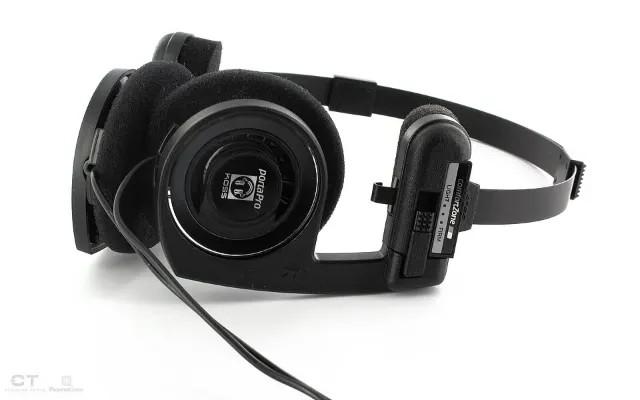
Koss Porta Pro
On-ear classic from 1984 that folds into a pocket and plays loud from anything. Koss publishes only a handful of specs for it.

Why it suits vinyl
- Our estimate is about 0.22 V for 100 dB: the easiest load here along with the ATH-M50x, so any phone, laptop or receiver jack will do.
- Folds small (Koss: "they fold up neatly into a compact size"), so it can live next to the turntable and still go out with you.
- Koss lists a limited lifetime warranty on the product page.
Watch out for
- The cable is 4 ft (about 1.2 m). From a receiver on a shelf you will likely need an extension cable.
- Koss doesn't publish whether it is open or closed, its weight, or its driver size.
- On-ear, not over-ear: the pads sit on your ears rather than around them.
Published specs
- Open or closed
- not published
- Fit
- On-ear
- Driver
- Dynamic, size not published
- Impedance
- 60 Ω
- Sensitivity
- 101 dB SPL at 1 mW
- Weight
- not published
- Cable
- 4 ft (about 1.2 m), dual entry; detachable: not published
- Plug
- 3.5 mm plug
- Volts for 100 dB
- about 0.22 V how
- Jack should be under
- 7.5 Ω output impedance why
- Koss product page: open/closed, fit, driver, impedance, sensitivity, weight, cable, connector. Checked 27 Oct 2026.
- Frequency-response measurements: oratory1990 · crinacle (GRAS 43AG-7) (via the AutoEq project).
Pick 5 · Best first open-back without an amp
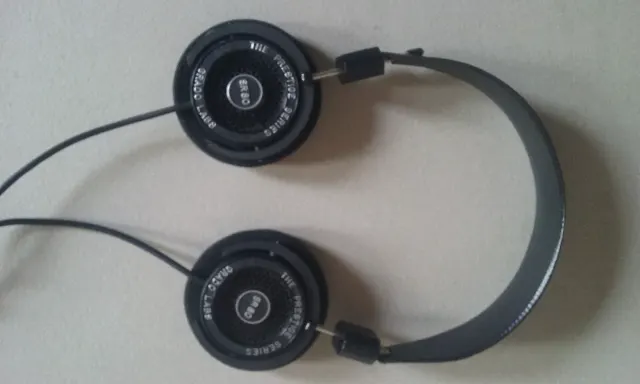
Grado SR80
Grado's best-selling open-back, now on a 44 mm X2 driver. Easy to drive at 38 Ω, but Grado publishes few physical specs.

Why it suits vinyl
- Open-back sound without buying an amp: our estimate is about 0.25 V for 100 dB at 38 Ω.
- Grado calls it "the most recognized headphone in the history of Grado" and its best-selling model.
- Grado tunes with ear cushions and sells alternatives, so you can change the presentation without changing headphones.
Watch out for
- Grado doesn't publish the weight, cable length or plug type. Check the cable reaches your receiver before you buy.
- The cable is fixed.
- The model was updated with the X2 driver. The public measurement is of the older SR80e, so the current SR80 may differ.
- Open-back: it leaks sound both ways.
Published specs
- Open or closed
- Open
- Fit
- not published
- Driver
- Dynamic, 44 mm
- Impedance
- 38 Ω
- Sensitivity
- 98 dB SPL at 1 mW
- Weight
- not published
- Cable
- length not published; fixed
- Plug
- not published
- Volts for 100 dB
- about 0.25 V how
- Jack should be under
- 4.8 Ω output impedance why
- Grado product page: open/closed, fit, driver, impedance, sensitivity, weight, cable, connector. Checked 27 Oct 2026.
- Frequency-response measurements: crinacle (GRAS 43AG-7), earlier SR80e model (via the AutoEq project).
Pick 6 · Best open-back upgrade
Sennheiser HD 660S2
Same 300 Ω family as the HD 600 but about 7 dB more sensitive by Sennheiser's figures, with a balanced cable in the box.
Why it suits vinyl
- Same 300 Ω load as the HD 600, so it is just as relaxed about receiver headphone jacks.
- Sennheiser's figure is 104 dB at 1 V against the HD 600's 97 dB. Our estimate is about 0.63 V for 100 dB, so it gets loud on more receivers.
- A 6.3 mm cable and a 4.4 mm balanced cable come in the box, so a balanced headphone amp later needs no new cable.
Watch out for
- The cables are 1.8 m, against 3 m on the HD 600. From a shelf to a chair you may need an extension.
- Open-back: it leaks sound both ways.
- Sennheiser's page lists two cables but never says "detachable" in so many words, so we mark that field as not published.
Published specs
- Open or closed
- Open
- Fit
- Over-ear
- Driver
- Dynamic, 38 mm
- Impedance
- 300 Ω
- Sensitivity
- 104 dB SPL at 1 V
- Weight
- 260 g
- Cable
- 2 cables, 1.8 m each; detachable: not published
- Plug
- 6.3 mm plug and 4.4 mm balanced plug; 6.3 to 3.5 mm adapter
- Volts for 100 dB
- about 0.63 V how
- Jack should be under
- 37.5 Ω output impedance why
- Sennheiser product page: open/closed, fit, driver, impedance, sensitivity, weight, cable, connector. Checked 27 Oct 2026.
- Frequency-response measurements: oratory1990 (via the AutoEq project).
Side by side
Swipe the table sideways to see all six.
| Spec | Sennheiser HD 600 | beyerdynamic DT 770 PRO (80 Ω) | Audio-Technica ATH-M50x | Koss Porta Pro | Grado SR80 | Sennheiser HD 660S2 |
|---|---|---|---|---|---|---|
| Pick | Best overall | Closed-back, shared room | Easiest to drive | Budget | First open-back | Open-back upgrade |
| Open or closed | Open | Closed | Closed | not published | Open | Open |
| Fit | Over-ear | Over-ear | Over-ear | On-ear | not published | Over-ear |
| Driver | Dynamic, 42 mm | Dynamic, size not published | Dynamic, 45 mm | Dynamic, size not published | Dynamic, 44 mm | Dynamic, 38 mm |
| Impedance | 300 Ω | 80 Ω | 38 Ω | 60 Ω | 38 Ω | 300 Ω |
| Sensitivity | 97 dB SPL at 1 V | 96 dB (1 mW or 1 V not stated) | 99 dB SPL at 1 mW | 101 dB SPL at 1 mW | 98 dB SPL at 1 mW | 104 dB SPL at 1 V |
| Volts for 100 dB (estimate) | ≈1.4 V | 0.45–1.6 V | ≈0.22 V | ≈0.22 V | ≈0.25 V | ≈0.63 V |
| Weight | 260 g | 345 g | 285 g without cable | not published | not published | 260 g |
| Cable length | 3 m | 3 m | 1.2 m, 3 m, coiled | 4 ft (~1.2 m) | not published | 1.8 m ×2 |
| Detachable cable | Yes | No, fixed | Yes | not published | No, fixed | not published |
| Plug | 3.5 mm + 6.3 mm adapter | 3.5 mm + 6.35 mm adapter | 3.5 mm + 6.3 mm adapter | 3.5 mm | not published | 6.3 mm, 4.4 mm balanced, 3.5 mm adapter |
Volts for 100 dB is our estimate from the published sensitivity and impedance (formula). Everything else is as the maker publishes it, checked 27 Oct 2026.
How we picked
- One clear situation per pick: a quiet room, a shared room, no amplifier, a small budget, a first open-back, a step up.
- Specs from the maker. Every number on this page comes from the maker’s product page or data sheet, checked on 27 Oct 2026 and linked under each pick. Gaps are marked “not published”.
- Measured by someone independent. Every pick has at least one public frequency-response measurement (for the Grado, of its predecessor, the SR80e), linked via the AutoEq project.
- Drivable from a typical setup, judged by the loudness estimate above, and a cable that reaches from a shelf to a chair or a clear warning when it doesn’t.
We have not run listening tests for this guide, and we don’t give scores. Where Max has used a pair himself, his notes will appear under that pick. The full method is on How we pick.
Not published by the maker:
- beyerdynamic DT 770 PRO (80 Ω): driver size, sensitivity reference (1 mW or 1 V)
- Koss Porta Pro: open or closed, driver size, weight, whether the cable detaches
- Grado SR80: fit, weight, cable length, plug
- Sennheiser HD 660S2: whether the cable detaches
Considered but left out: HIFIMAN Arya Stealth (HIFIMAN's product page returned 404 when we fetched it, so we could not check its specs at the source.)
Questions
Do I need a headphone amp for vinyl?
Not if your receiver or amplifier has a headphone jack and your headphones are on the easy side of the loudness table. You need one if nothing in your chain has a headphone jack, or for the HD 600, which wants about 1.4 V for loud peaks.
Open-back or closed-back for records?
Open-back headphones let sound out and in, so they suit a quiet room where you listen alone. Closed-back headphones keep the sound to yourself and block some room noise, which matters if someone else is in the room or the TV is on.
Can I use the headphones I already have?
Yes. Look up their impedance and sensitivity, put them through the formula, and compare with what your receiver or amp can deliver.
Photo credits and sources
- Sennheiser HD 600: photo by Benutzer123 (German Wikipedia), brightened by Ulfbastel, CC BY-SA 3.0, source on Wikimedia Commons; converted to WebP; thumbnail cropped.
- beyerdynamic DT 770 PRO (80 Ω): photo by Mike Russell, CC BY 2.0, source on Wikimedia Commons; resized, converted to WebP; thumbnail cropped.
- Audio-Technica ATH-M50x: our own drawing (no reuse-licensed photo found).
- Koss Porta Pro: photo by Creative Tools (Halmstad, Sweden), CC BY 2.0, source on Wikimedia Commons; cropped (photographer's mark kept), resized, converted to WebP; thumbnail cropped.
- Grado SR80: photo by Bizzarle, CC BY-SA 4.0, source on Wikimedia Commons; resized, converted to WebP; thumbnail cropped.
- Sennheiser HD 660S2: our own drawing (no reuse-licensed photo found).
- Sources for every spec are linked under each pick. Impedance rule of thumb: NwAvGuy. Measurements: AutoEq project, results by oratory1990 and crinacle.