Buying guide · DJ headphones
Best DJ headphones
Six wired pairs for six DJ situations, picked from the makers’ own spec sheets: which cups turn for one-ear cueing, which cables coil and lock, and which parts you can buy again.
No scores, no lab claims. Shop links are plain links; they may earn us a commission later. How we pick
 Best overall for most DJsSennheiser HD 25
On-ear · closed · 140 g
Rotating cup · every wearing part sold as a spare See it at Thomann
Cups swivel and rotate · coiled and straight cable, twist lock See it at Pioneer DJ
Cups rotate 90° · coiled and straight cable · spare pads in the box See it at Pioneer DJ
Modular: every part sold separately · coiled cable that locks See it at AIAIAI
270° swivel that locks · locking cord, coiled and straight See it at Thomann
90° swivelling cups · three cables, one coiled See it at Thomann
What actually matters in a DJ headphone
Impedance across these six runs from 32 to 70 Ω, and how loud each gets from the same output is estimated below. The bigger differences are in how a pair handles cueing in one ear while the room plays the other track, and how long it lasts in a bag, on a sweaty head, with a cable that gets yanked. Six things decide it, and spec sheets show most of them:
- One-ear monitoringYou cue the next track in one ear and hear the room in the other. Look for cups that rotate or swivel off the ear; some lock in place.
- IsolationTo hear your cue over the PA, closed-back is the baseline, and the pads do the rest: on-ear pads press on the ear, over-ear pads seal around it. None of these six makers publishes isolation in dB.
- CableA coiled cable stretches across a booth and springs back; a straight one is lighter at home. A detachable cable that locks in is the part you replace instead of the headphones.
- Spare partsEar pads and cables wear out first. A maker that sells them as spares lets you keep the same pair going.
- Weight and clampA set is hours on your head, so lighter is easier on the neck, and clamp keeps on-ear pairs in place when you move. Only Sennheiser publishes a clamp figure here.
- LoudnessWhat differs is how loud each pair gets from the same headphone output, which matters on a controller with a weak one. Our estimate is below.
How loud from your controller? An estimate
The makers publish how loud each pair plays for a given input. We convert that to one common number: how loud each pair gets from 1 volt, the same signal for all of them. A higher number means louder from the same headphone output at the same knob position.
| Headphone | Impedance | Sensitivity, as published | Loudness at 1 V (estimate) |
|---|---|---|---|
| Sennheiser HD 25 | 70 Ω | not published (only a maximum of 120 dB SPL is given) | can’t estimate |
| Pioneer DJ HDJ-X7 | 36 Ω | 102 dB (1 mW or 1 V not stated) | 102–116 dB |
| Pioneer DJ HDJ-CX | 32 Ω | 103 dB (1 mW or 1 V not stated) | 103–118 dB |
| AIAIAI TMA-2 DJ | 32 Ω | 97 dB SPL at 1 mW | ≈112 dB |
| Technics EAH-DJ1200 | 45 Ω | 106 dB SPL at 1 mW | ≈119 dB |
| Audio-Technica ATH-M50x | 38 Ω | 99 dB SPL at 1 mW | ≈113 dB |
The formula. Makers state sensitivity either per volt or per milliwatt:
S is the published sensitivity in dB; Z is the impedance in ohms.
Our assumptions, not measurements. If you know your controller’s headphone output in volts (look for “headphone output level” in its manual), add 20 × log10(volts) to the number above: about +6 dB at 2 V, about −6 dB at 0.5 V. Pioneer DJ doesn’t say whether its sensitivity figures are per milliwatt or per volt, so its two pairs get a range. Sennheiser publishes no sensitivity for the HD 25, only a maximum of 120 dB SPL, so we can’t place it. On these numbers the Technics EAH-DJ1200 is the loudest from the same output.
The picks in detail
Each pick says what it suits and what to watch for, using only the published specs below it. Where a maker doesn’t publish a spec, we say so rather than fill it in.
Pick 1 · Best overall for most DJs
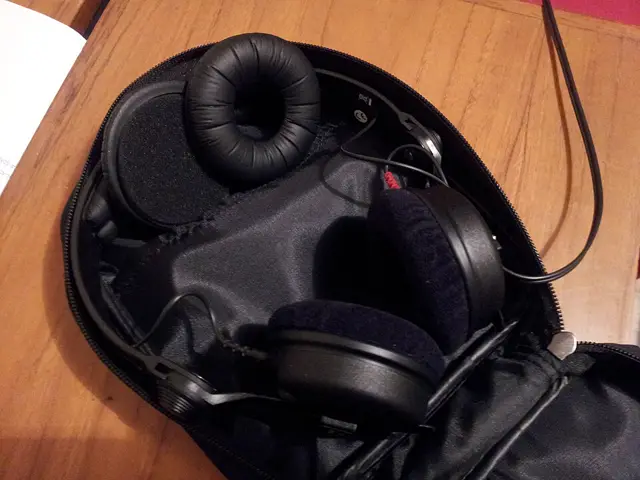
Sennheiser HD 25
Light, closed and on-ear, with a cup that rotates off the ear and a spare-parts list that covers everything that wears out. The safe default for the booth and the bedroom.

Why it suits DJing
- Sennheiser lists a rotating ear cup for single-ear monitoring: one cup on, one off, which is how most DJs cue.
- About 140 g without cable, with a published contact pressure of about 2.5 N. It is the only pick here whose maker states its clamp.
- The maker’s spare-parts list covers what wears out: ear pads in leather or velour, a 3 m coiled cable, a 1.5 m straight cable, a headband pad and a strain relief, with replacement instructions for the cable and pads.
Watch out for
- Only the 1.5 m straight cable is in the box. A coiled cable for the booth is a separate part.
- Sennheiser publishes no sensitivity, only a maximum of 120 dB SPL, so we can’t estimate how loud it plays from a given headphone output.
- Sennheiser describes the headband as having a “strong clamping force”. That keeps on-ear pads in place when you move, but it is a firm fit by design.
Published specs
- Open or closed
- Closed
- Fit
- On-ear
- One-ear monitoring
- One cup rotates for single-ear monitoring
- Cables in the box
- One 1.5 m straight cable, single-sided; detachable
- Cable lock
- not published
- Spare parts
- Ear pads (leather or velour), 3 m coiled cable, 1.5 m straight cable, headband pad, strain relief
- Weight
- about 140 g without cable
- Clamp force
- about 2.5 N
- Folds
- not published
- Driver
- Dynamic, size not published
- Impedance
- 70 Ω
- Sensitivity
- not published (only a maximum of 120 dB SPL is given)
- Loudness at 1 V
- can’t estimate (no sensitivity published) how
- Plug
- 3.5 mm plug, 6.3 mm screw-on adapter included
- Sennheiser product page: open/closed, fit, one-ear monitoring, cables, cable lock (not published), spare parts, folding (not published), driver, impedance, sensitivity, plug. Checked 27 Oct 2026.
- Sennheiser HD 25 product specification (PDF): weight, clamp force. Checked 27 Oct 2026.
- Sennheiser: HD 25 replacement instructions: The Downloads list has instructions for replacing the cable and the ear pads; the page also mentions "field-replaceable parts" and a "minimal headband with strong clamping force".
- Frequency-response measurement: Rtings (B&K 5128) (via the AutoEq project).
Pick 2 · Best over-ear for the club booth
Pioneer DJ HDJ-X7
Over-ear and closed, with cups that swivel and rotate, a cable that twists to lock into the cup, and both a coiled and a straight cable in the box. Pads and both cables are sold as spares.
Why it suits DJing
- The ear pieces swivel front to back and each housing rotates outward; the manual says it “allows listening with only one ear”.
- Two detachable cables in the box: 1.2 m coiled (3.0 m stretched) for the booth and 1.6 m straight for home. The plug twists about 45° to lock into the cup.
- Pioneer DJ sells the ear pads (HC-EP0601) and both cables (HC-CA0601, HC-CA0602) as spares.
- Folds into the supplied carrying pouch.
Watch out for
- At 312 g without cable it is the heaviest pick here, more than twice the HD 25 or the HDJ-CX.
- Pioneer DJ doesn’t say whether its 102 dB sensitivity is per milliwatt or per volt, so our loudness figure is a range.
- The locking plug is Pioneer DJ’s own design. The manual says cables from the older HDJ-1500, HDJ-700 and HDJ-500 don’t fit, so buy replacement cables made for the HDJ-X range.
Published specs
- Open or closed
- Closed
- Fit
- Over-ear
- One-ear monitoring
- Cups swivel front to back and rotate outward; “allows listening with only one ear”
- Cables in the box
- 1.2 m coiled (3.0 m stretched) and 1.6 m straight, single-sided; detachable
- Cable lock
- Plug twists about 45° to lock into the cup
- Spare parts
- Ear pads (HC-EP0601), 1.2 m coiled cable (HC-CA0601), 1.6 m straight cable (HC-CA0602)
- Weight
- 312 g without cable
- Clamp force
- not published
- Folds
- Yes, into a carrying pouch (included)
- Driver
- Dynamic, 50 mm
- Impedance
- 36 Ω
- Sensitivity
- 102 dB (1 mW or 1 V not stated)
- Loudness at 1 V
- 102–116 dB how
- Plug
- 3.5 mm plug, 6.3 mm screw-on adapter included
- Pioneer DJ HDJ-X7 manual (PDF): open/closed, one-ear monitoring, cables, cable lock, weight, folding, driver, impedance, sensitivity, plug. Checked 27 Oct 2026.
- Pioneer DJ product page: fit, spare parts, clamp force (not published). Checked 27 Oct 2026.
Pick 3 · Lightest for long sets
Pioneer DJ HDJ-CX
136 g, the lightest pair here, yet it still comes with a coiled and a straight cable, a twist-lock socket and a spare pair of ear pads.
Why it suits DJing
- 136 g without cable: the lightest of the six, less than half the weight of the over-ear HDJ-X7.
- Either cup rotates 90° forward or back, away from the ear, for one-ear monitoring. A screw sets how stiffly it turns.
- A 1.2 m coiled cable (3.0 m stretched) and a 1.6 m straight cable, both detachable, with a twist lock at the cup.
- A spare pair of ear pads comes in the box, and a clip holds the 6.3 mm adapter on the cable.
Watch out for
- The rotation can’t be locked in place. The manual says: “Rotation cannot be completely locked.”
- Pioneer DJ lists no spare parts for the HDJ-CX on its product page; the one spare pair of pads in the box is all that is published.
- As with the HDJ-X7, the sensitivity is given without saying per milliwatt or per volt, so our loudness figure is a range.
Published specs
- Open or closed
- Closed
- Fit
- On-ear
- One-ear monitoring
- Each cup rotates 90° forward or back, away from the ear; stiffness set by a screw, can’t be locked
- Cables in the box
- 1.2 m coiled (3.0 m stretched) and 1.6 m straight, single-sided; detachable
- Cable lock
- Plug twists about 45° to lock into the cup
- Spare parts
- A spare pair of ear pads in the box; no spare parts listed for sale
- Weight
- 136 g without cable
- Clamp force
- not published
- Folds
- not published
- Driver
- Dynamic, 35 mm
- Impedance
- 32 Ω
- Sensitivity
- 103 dB (1 mW or 1 V not stated)
- Loudness at 1 V
- 103–118 dB how
- Plug
- 3.5 mm plug, 6.3 mm screw-on adapter and adapter holder included
- Pioneer DJ HDJ-CX manual (PDF): open/closed, one-ear monitoring, cables, cable lock, spare parts, driver, impedance, sensitivity, plug. Checked 27 Oct 2026.
- Pioneer DJ product page: fit, weight, clamp force (not published), folding (not published). Checked 27 Oct 2026.
Pick 4 · Most repairable: every part comes apart
AIAIAI TMA-2 DJ
Built from separate parts: speaker units, headband, ear pads and cable each come off and are sold on their own, so a broken part means buying one part, not a new pair.
Why it suits DJing
- AIAIAI sells each part on its own: speaker units, headbands, ear pads and cables. You can also swap the on-ear pads for over-ear ones.
- A 1.5 m coiled cable that stretches to 3.2 m, locked to the speaker unit, with an angled plug at the mixer end.
- 190 g, third lightest of the six.
Watch out for
- AIAIAI lists no swivel or rotating cup; its “adjustable cups” are for fit. To cue with one ear you push one cup off.
- 97 dB at 1 mW makes it the quietest of the four pairs whose makers say how sensitivity is measured: on our estimate about 7 dB quieter than the Technics from the same headphone output (see the loudness table).
- AIAIAI doesn’t say whether the cups are closed-back (it says “high sound isolation”) or whether the 190 g includes the cable.
Published specs
- Open or closed
- not published
- Fit
- On-ear
- One-ear monitoring
- not published
- Cables in the box
- 1.5 m coiled, stretches to 3.2 m; detachable
- Cable lock
- Locks to the speaker unit
- Spare parts
- Modular: speaker units, headband, ear pads and cables are separate parts; over-ear pads and other cables offered
- Weight
- 190 g (AIAIAI doesn’t say whether that includes the cable)
- Clamp force
- not published
- Folds
- not published
- Driver
- 40 mm, bio-cellulose diaphragm
- Impedance
- 32 Ω
- Sensitivity
- 97 dB SPL at 1 mW
- Loudness at 1 V
- about 112 dB how
- Plug
- 3.5 mm angled plug, 6.3 mm screw-on adapter included
- AIAIAI product page: open/closed (not published), fit, one-ear monitoring (not published), cables, cable lock, spare parts, weight, clamp force (not published), folding (not published), driver, impedance, sensitivity, plug. Checked 27 Oct 2026.
- AIAIAI: TMA-2 DJ buy page: Lists over-ear PU leather ear pads (E04) and a second coiled cable (C18) as accessories, and the same 97 dB @ 1 mW sensitivity.
- Frequency-response measurement: Rtings (B&K 5128) (via the AutoEq project).
Pick 5 · Best for one-ear cueing: the swivel locks
Technics EAH-DJ1200
On-ear, with a 270° swing arm that locks in place for one-ear monitoring, a locking cord, and the highest published sensitivity of the six: the pick for a controller with a weak headphone output.
Why it suits DJing
- The swivel locks. Technics says the housings have “lockable swiveling mechanisms” for one-ear monitoring, on a 270° swing arm.
- A locking detachable cord, with a 1.2 m straight and a 1.5 m coiled cord (about 2.2 m stretched) in the box.
- 106 dB at 1 mW and 45 Ω: on our estimate the loudest of the six from the same headphone output.
- Folds compactly.
Watch out for
- Technics lists no replacement ear pads or cords on its product page.
- The English pages don’t say closed-back; only Panasonic’s Japanese press release does (密閉型, closed type).
- The UK spec page prints the stretched coiled cord as “2.2 mm”. Panasonic’s Japanese press release gives about 2.2 m.
Published specs
- Open or closed
- Closed
- Fit
- On-ear
- One-ear monitoring
- 270° swing arm; the swivel locks
- Cables in the box
- About 1.2 m straight and about 1.5 m coiled (about 2.2 m stretched), both L-shaped plugs; detachable
- Cable lock
- Locking cord
- Spare parts
- not published
- Weight
- about 233 g without cord
- Clamp force
- not published
- Folds
- Yes
- Driver
- Dynamic, 40 mm
- Impedance
- 45 Ω
- Sensitivity
- 106 dB SPL at 1 mW
- Loudness at 1 V
- about 119 dB how
- Plug
- 3.5 mm plug, 6.3 mm adapter included
- Panasonic press release (Japanese): open/closed. Checked 27 Oct 2026.
- Technics UK product page: fit, one-ear monitoring, cables, cable lock, spare parts (not published), weight, clamp force (not published), folding, driver, impedance, sensitivity, plug. Checked 27 Oct 2026.
- Panasonic press release (Japanese): EAH-DJ1200: Type 密閉型 (closed); both cords L-shaped (L型); coiled cord about 1.5 m, about 2.2 m stretched.
- Note, cables: Technics UK prints the stretched coiled cord as “2.2 mm”; Panasonic’s Japanese press release gives about 2.2 m (約 2.2 m), which we use.
Pick 6 · Best for studio work and DJing
Audio-Technica ATH-M50x
A closed, over-ear studio monitor whose cups swivel 90° for one-ear monitoring, with three cables in the box including a coiled one. One pair for producing and for the decks.
Why it suits DJing
- Audio-Technica lists “90° swiveling earcups for easy, one-ear monitoring”.
- Three detachable cables in the box: a 1.2–3.0 m coiled one for the decks and 3.0 m and 1.2 m straight ones for the studio. They lock in with a bayonet fitting (per Audio-Technica Japan).
- Audio-Technica’s HP-EP replacement ear pads list the ATH-M50x as compatible.
- Folds flat for the bag.
Watch out for
- 285 g without cable, second heaviest here after the HDJ-X7.
- The bayonet-lock cables are Audio-Technica’s own fitting. Buy replacements made for it.
- Audio-Technica US gives sensitivity as 99 dB without a reference; we use the Japanese page’s 99 dB/mW.
Published specs
- Open or closed
- Closed
- Fit
- Over-ear
- One-ear monitoring
- Cups swivel 90° for one-ear monitoring
- Cables in the box
- 3 cables: 1.2–3.0 m coiled, 3.0 m straight, 1.2 m straight; detachable
- Cable lock
- Bayonet lock at the cup
- Spare parts
- Replacement ear pads (HP-EP) sold separately
- Weight
- 285 g without cable
- Clamp force
- not published
- Folds
- Yes
- Driver
- Dynamic, 45 mm
- Impedance
- 38 Ω
- Sensitivity
- 99 dB SPL at 1 mW
- Loudness at 1 V
- about 113 dB how
- Plug
- 3.5 mm plug, 6.3 mm screw-on adapter included
- Audio-Technica product page: open/closed, fit, one-ear monitoring, cables, weight, clamp force (not published), folding, driver, impedance, plug. Checked 27 Oct 2026.
- Audio-Technica Japan product page: cable lock, sensitivity. Checked 27 Oct 2026.
- Audio-Technica HP-EP ear pads page: spare parts. Checked 27 Oct 2026.
- Frequency-response measurement: oratory1990 · crinacle (GRAS 43AG-7) (via the AutoEq project).
Side by side
| Headphone | Fit | Closed? | One ear | Cables | Lock | Spares | Weight | At 1 V (est.) |
|---|---|---|---|---|---|---|---|---|
| Sennheiser HD 25Best overall | On-ear | Closed | Rotating cup | 1.5 m straight | not published | Pads, both cables, headband pad | 140 g | can’t estimate |
| Pioneer DJ HDJ-X7Over-ear for the booth | Over-ear | Closed | Swivel and rotate | 1.2 m coiled + 1.6 m straight | Twist lock | Pads, both cables | 312 g | 102–116 dB |
| Pioneer DJ HDJ-CXLightest | On-ear | Closed | Rotates 90° | 1.2 m coiled + 1.6 m straight | Twist lock | Spare pads in the box | 136 g | 103–118 dB |
| AIAIAI TMA-2 DJModular | On-ear | not published | not published | 1.5 m coiled | Cable lock | Every part | 190 g | ≈112 dB |
| Technics EAH-DJ1200Locking swivel | On-ear | Closed | 270° swivel, locks | 1.2 m straight + 1.5 m coiled | Locking cord | not published | 233 g | ≈119 dB |
| Audio-Technica ATH-M50xStudio + DJ | Over-ear | Closed | Swivels 90° | Coiled + 3 m + 1.2 m straight | Bayonet lock | Pads | 285 g | ≈113 dB |
Loudness at 1 V is our estimate from the published sensitivity and impedance (formula). Everything else is as the maker publishes it, checked 27 Oct 2026.
How we picked
- One clear situation per pick: most DJs, a loud booth, long sets, a pair you repair rather than replace, one-ear cueing on a swivel that locks, and one pair for the studio and the decks.
- DJ features first. Cups that turn for one-ear cueing, the cables in the box and whether they lock, spare parts, isolation (closed-back, on-ear or over-ear) and weight. Loudness only as a check that a controller can drive them.
- Specs from the maker. Every number on this page comes from the maker’s product page, manual or press release, checked on 27 Oct 2026 and linked under each pick. Gaps are marked “not published”.
- Wired only. Bluetooth adds a delay that makes cueing by ear hard, so wireless DJ headphones are a different buying question. AIAIAI, for example, sells a TMA-2 DJ Wireless with its own transmitter.
We have not tested these headphones for this guide, and we don’t give scores. An independent frequency-response measurement exists for the Sennheiser HD 25, AIAIAI TMA-2 DJ and Audio-Technica ATH-M50x, linked under those picks; we found none for the others. Where Max has used a pair himself, his notes will appear under that pick. The full method is on How we pick.
Not published by the maker:
- Sennheiser HD 25: cable lock, folding, sensitivity, driver size
- Pioneer DJ HDJ-X7: clamp force, sensitivity reference (1 mW or 1 V)
- Pioneer DJ HDJ-CX: clamp force, folding, sensitivity reference (1 mW or 1 V)
- AIAIAI TMA-2 DJ: open/closed, one-ear monitoring, clamp force, folding
- Technics EAH-DJ1200: spare parts, clamp force
- Audio-Technica ATH-M50x: clamp force
Considered but left out: V-MODA Crossfade M-100 Master (v-moda.com sent us to its home page instead of the product page, so we could not check its specs at the source); Pioneer DJ HDJ-CUE1 (its manual is a scanned PDF with no readable text and the product page lists no specs, so we could not check them); Pioneer DJ HDJ-X10 (the HDJ-X7’s bigger sibling: more sensitive on paper (106 dB), but 328 g without cable); Pioneer DJ HDJ-X5 (40 mm drivers instead of 50 mm and only a coiled cable in the box); AIAIAI TMA-2 DJ XE (lighter (168 g) with a slim headband, but a straight cable instead of a coiled one).
Questions
Do I need a headphone amp for DJing?
No. Every DJ mixer and controller has a headphone output with its own level control. The only question is how loud a given pair gets from it, which is what the loudness estimate compares.
On-ear or over-ear for DJing?
Here the on-ear pairs (HD 25, HDJ-CX, TMA-2 DJ, EAH-DJ1200) are the light ones, 136 to 233 g, and press on the ear. The over-ear pairs (HDJ-X7, ATH-M50x) sit around the ear and weigh 285 to 312 g. Either kind can isolate well when it is closed-back; which feels better over a long set is personal.
Coiled or straight cable?
Coiled for a booth or a controller on a table you move around: it stretches and springs back. Straight is lighter and tangles less for practice at home. The HDJ-X7, HDJ-CX, EAH-DJ1200 and ATH-M50x come with both; the TMA-2 DJ comes with a coiled one; the HD 25 comes with a straight one and sells a coiled one as a spare.
Can I use studio headphones to DJ?
Yes, if they are closed-back and the cups turn far enough to cue with one ear. The ATH-M50x is our pick for that: Audio-Technica lists 90° swivelling cups for one-ear monitoring and includes a coiled cable.
Do louder headphones mean better isolation?
No, they are separate things. Better isolation lets you cue at a lower level in a loud room, which is easier on your hearing. Loudness only tells you how much level a pair gets from the same output.
Photo credits and sources
- Sennheiser HD 25: photo by Jacques from Cape Town, South Africa, CC BY 2.0, source on Wikimedia Commons; resized, converted to WebP; thumbnail cropped.
- Pioneer DJ HDJ-X7: our own drawing (no reuse-licensed photo found).
- Pioneer DJ HDJ-CX: our own drawing (no reuse-licensed photo found).
- AIAIAI TMA-2 DJ: our own drawing (no reuse-licensed photo found).
- Technics EAH-DJ1200: our own drawing (no reuse-licensed photo found).
- Audio-Technica ATH-M50x: our own drawing (no reuse-licensed photo found).
- Sources for every spec are linked under each pick. Measurements: AutoEq project, results by Rtings, oratory1990 and crinacle.